
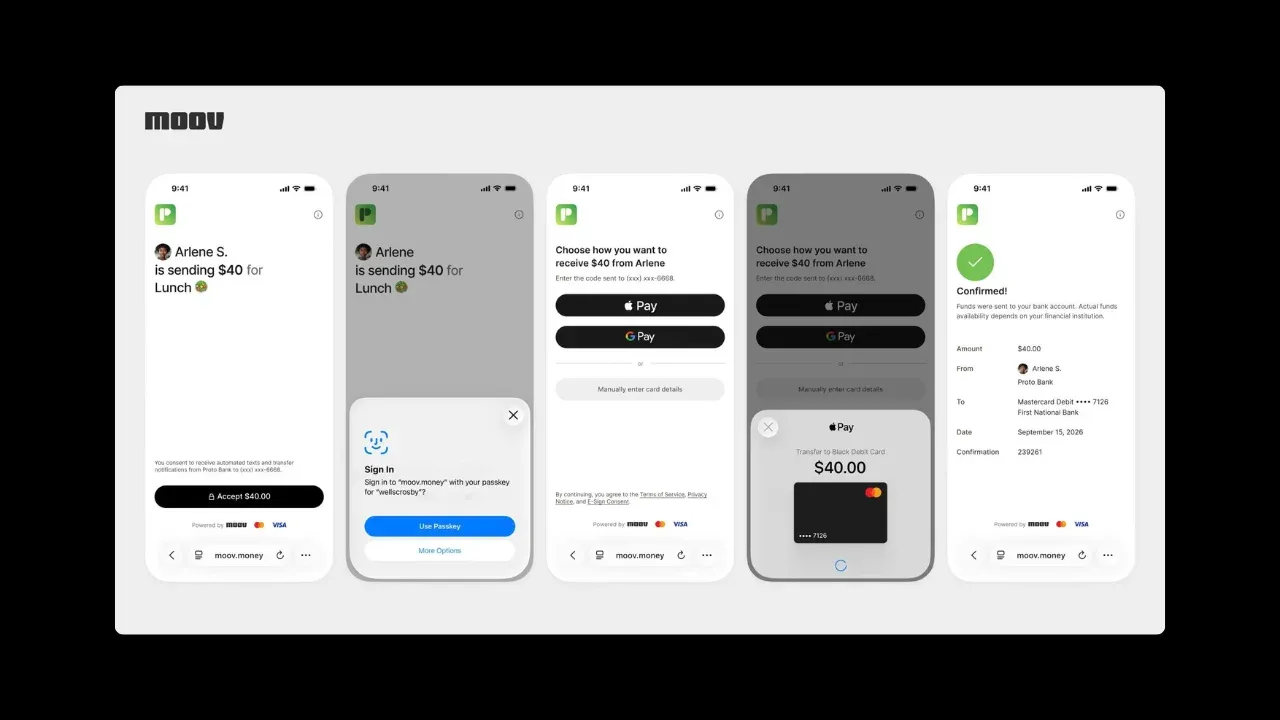
Moov Financial, Inc. is attempting to disrupt the fragmented person-to-person (P2P) payment landscape by decoupling money movement from proprietary app ecosystems. By launching Moov Money, the company is positioning its technology as an interoperable bridge that utilizes existing debit card infrastructure rather than requiring users to inhabit specific digital walled gardens. Developed in collaboration with Visa and Mastercard, the solution aims to allow consumers to send and receive funds through their primary banking interfaces using only an eligible debit card and a mobile connection. This strategic move targets the significant market gap where no single P2P provider currently reaches more than 34.6% of U.S. consumers, according to Federal Reserve Bank of Atlanta research.
Moov Money Integrates Visa and Mastercard Networks
The Moov Money platform functions by connecting card networks to a P2P experience, specifically leveraging Mastercard Move and Visa Direct. Rather than forcing participants into a closed loop, the technology uses the debit card as the ultimate payment destination. This approach addresses a critical consumer reality: the Federal Reserve Bank of Atlanta’s 2025 Survey and Diary of Consumer Payment Choice indicates that 90.5% of U.S. consumers carry a debit card. By utilizing these credentials, Moov intends to enable payments between users regardless of which specific banking application they utilize.
To facilitate this, Moov provides the underlying connectivity that links a recipient’s phone number or contact information to their eligible payment credentials. This mechanism is designed to populate payment destinations automatically, potentially removing the necessity for manual card detail entry. Beyond simple connectivity, Moov is providing the full operational stack for participating institutions, including identity verification, fraud controls, and dispute management. The company is also offering tokenized card credentials for recipients using Mastercard Credential Services or leading mobile wallets, allowing for seamless acceptance without manual input.
Expanding Reach via Jack Henry Banno Integration
Moov is prioritizing rapid distribution through strategic partnerships with established financial infrastructure providers. The Jack Henry Banno Digital Platform™ has become the first to integrate Moov Money, a move that provides over 1,000 banks and credit unions with an immediate pathway to offer modern P2P capabilities. This turnkey integration allows community banks and credit unions to embed these services directly into their existing digital banking environments, maintaining the primary customer relationship and keeping deposits within the institution.
The platform is currently available to banks, credit unions, neobanks, and brokerages for domestic P2P transactions. By managing tier-one support, fraud monitoring, and disputes on behalf of these institutions, Moov is positioning itself as an outsourced operational layer. This model allows smaller financial entities to compete with larger fintech players by offering sophisticated, real-time money movement without the heavy lifting of building proprietary rails. The company’s goal is to enable these institutions to meet evolving consumer expectations for universal, secure, and embedded financial experiences while ensuring the engagement remains under the institution's own brand.
Key Takeaways
- Moov Money utilizes Mastercard Move and Visa Direct to enable P2P payments via existing debit card credentials.
- The solution integrates with Jack Henry’s Banno Digital Platform, providing access to over 1,000 financial institutions.
- Moov provides the operational infrastructure, including identity verification, AI-powered fraud detection, and dispute management.
FinanceInsyte's Take
In our view, Moov is executing a calculated strike against the "app-lock" model that currently defines the P2P market. By leveraging the 90.5% debit card penetration rate identified by the Federal Reserve, Moov is not trying to build a new consumer habit, but rather to optimize an existing one. This is a significant strategic pivot for mid-tier banks and credit unions; instead of losing transaction volume and customer engagement to dominant P2P apps, they can now offer interoperable services that keep deposits local. The heavy reliance on Visa and Mastercard infrastructure suggests that Moov is positioning itself as a sophisticated orchestration layer rather than a direct competitor to the networks. If successful, this could shift the competitive advantage from those who own the consumer interface to those who own the most efficient, interoperable rails.
Questions & Answers
How does Moov Money differ from existing P2P applications?
Unlike many current P2P services that require both the sender and the recipient to use the same specific application, Moov Money uses the debit card as the payment destination. This allows for interoperability between different banking apps, as long as the recipient has an eligible Visa or Mastercard debit card.
What role do Visa and Mastercard play in this new solution?
Visa and Mastercard provide the underlying network infrastructure through Visa Direct and Mastercard Move. Moov provides the technology that connects these card networks to the P2P experience, handling the connectivity between phone numbers/contacts and the card credentials.
How does the platform address the security risks inherent in P2P transfers?
Moov implements a multi-layered security approach that includes device intelligence, phone-based identity verification, network-level card validation, and passkey authentication. Additionally, the platform utilizes real-time monitoring and AI-powered fraud detection to mitigate scams and losses.
Which financial institutions can currently access Moov Money?
The service is available to banks, credit unions, neobanks, and brokerages. Through the Jack Henry Banno Digital Platform, over 1,000 banks and credit unions can access the integration to offer P2P services within their own digital banking environments.
Source: Moov