
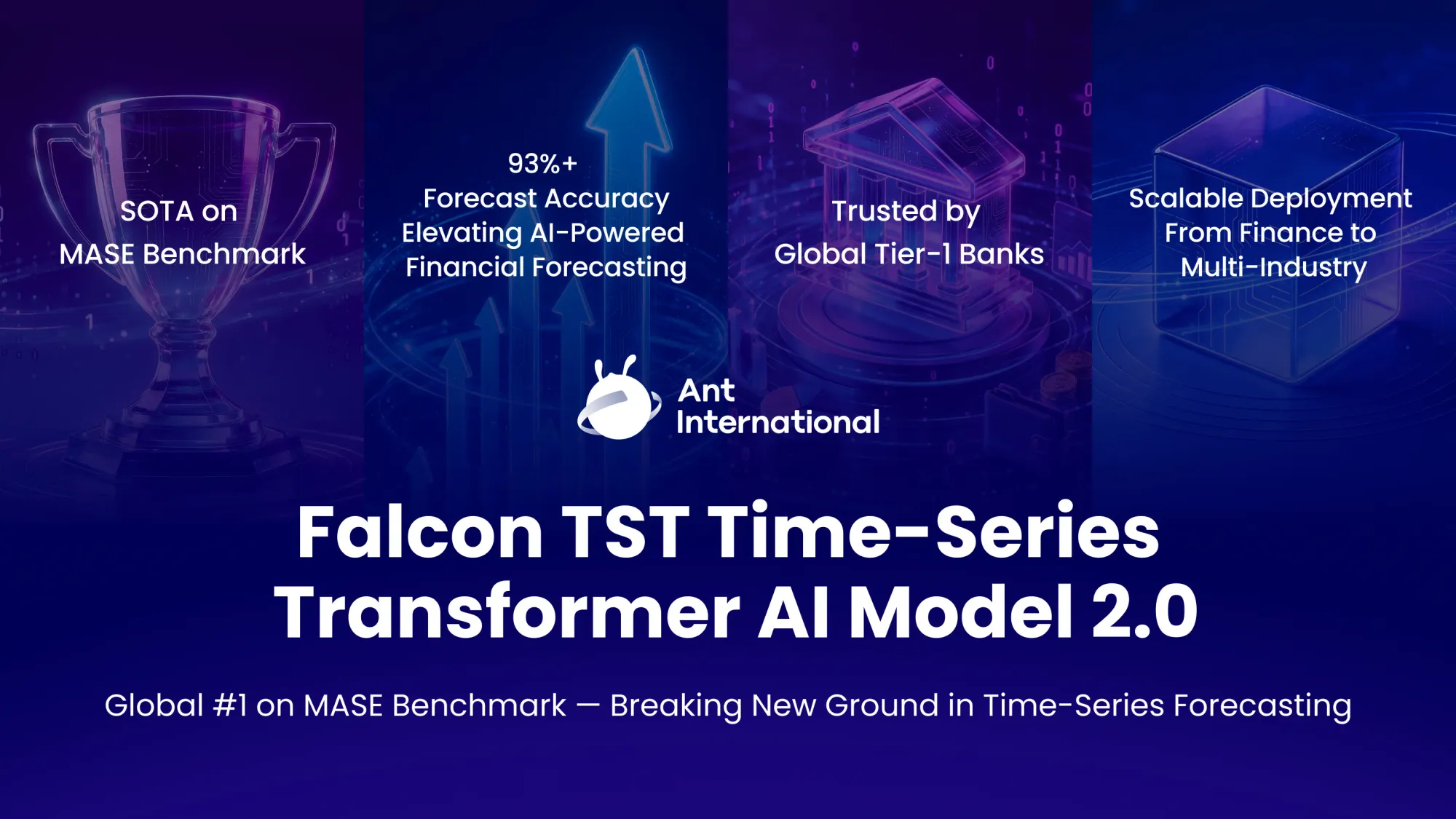
Ant International is positioning its latest AI advancement to redefine how global financial institutions manage liquidity and foreign exchange (FX) volatility. By launching the Falcon Time-Series Transformer (TST) Model 2.0, the company aims to transition predictive AI from a specialized tool into a foundational capability for cross-border commerce. The model has already achieved a State-of-the-Art (SOTA) performance on the Mean Absolute Scaled Error (MASE) metric, recording a score of 0.666 on a top global public benchmark. This technical milestone comes as major banking entities integrate the technology to stabilize cashflow forecasting and mitigate the risks inherent in rapid, multi-currency transaction flows across global markets.
FalconTST 2.0 Achieves SOTA Performance on MASE Metric
The release of FalconTST 2.0 marks a significant technical leap in time-series foundational modeling, specifically targeting the complexities of numerical financial data. Unlike large language models that prioritize text, this TST model is engineered to interpret continuously shifting variables such as settlement flows, account balances, and currency positions. The company reports that the model has achieved a consistent forecast accuracy rate exceeding 93%. This precision is intended to address the high-stakes environment of FX risk management, where over-hedging or under-hedging can lead to significant capital inefficiencies or unmitigated exposure.
Technically, the 2.0 iteration introduces several architectural improvements designed to handle the "noise" of real-world financial data. One key innovation is the advanced handling of missing data; the model is designed to distinguish between a genuine zero value and a gap in data, such as a lack of weekend transactions, to prevent misleading predictive patterns. Furthermore, the model utilizes ORBIT to learn common temporal structures—such as seasonality and sudden shifts—across diverse sectors including energy, retail, and tourism. This allows the model to support multiple time frequencies within a single architecture, ranging from second-level payment data to monthly economic indicators, providing a versatile framework for institutional deployment.
Global Banking Integration and Cross-Sector Expansion
The deployment of FalconTST 2.0 has moved beyond internal use at Ant International into the core infrastructure of several tier-one global banks. These institutions are leveraging the model to enhance their existing FX hedging and liquidity management systems. Specifically, Barclays has integrated the model into its BARX NetFX platform, while Citi has combined it with its Fixed FX Rates solution. These integrations primarily support FX risk management for sectors such as airlines and e-commerce platforms. Additionally, Standard Chartered is utilizing the model alongside its SCALE FX system as part of the PathFin.ai programme, an initiative involving the Monetary Authority of Singapore.
While the current primary beneficiaries are financial institutions, Ant International is signaling a strategic move to commoditize this forecasting capability across non-financial industries. The company is targeting sectors where temporal patterns are critical for operational stability, such as aviation demand forecasting and supply chain management for e-commerce. By training the model on shared underlying temporal structures across different industries, Ant International is attempting to move away from customized, single-use solutions toward a reusable, foundational AI capability. This expansion suggests a broader ambition to provide predictive intelligence that informs real-world capital allocation and operational decisions in logistics and travel.
Key Takeaways
- FalconTST 2.0 achieved a MASE score of 0.666, surpassing other TST foundational models on global benchmarks.
- Major financial institutions, including Barclays, Citi, Deutsche Bank, and Standard Chartered, have integrated the model for FX and liquidity management.
- The model maintains a consistent forecast accuracy rate of over 93% across its applications.
FinanceInsyte's Take
In our view, Ant International is executing a sophisticated play to move AI from the "experimental" phase into the "infrastructure" phase of financial services. By securing integration within the FX hedging platforms of Barclays and Citi, Ant is not just selling a tool; it is embedding its intelligence into the plumbing of global capital markets. The move to a "foundational" model—one that learns patterns across retail, energy, and finance—is a strategic attempt to achieve massive scale by reducing the need for industry-specific retraining. If FalconTST 2.0 can successfully bridge the gap between financial liquidity and industrial logistics, Ant International may well set the standard for how enterprises anticipate market shifts. The real test will be whether this "reusable" capability can maintain its 93% accuracy when faced with the highly idiosyncratic volatility of non-financial sectors like aviation and e-commerce.
Questions & Answers
How does FalconTST 2.0 differentiate between missing data and zero-value transactions?
The model features advanced handling of missing data designed to recognize that a lack of activity (such as no bank transactions over a weekend) does not equate to a demand of zero. This prevents the AI from generating misleading patterns that could compromise liquidity forecasts.
Which specific banking platforms are currently utilizing this technology?
Barclays has integrated the model into its BARX NetFX platform, Citi uses it in conjunction with its Fixed FX Rates solution, and Standard Chartered utilizes it alongside its SCALE FX system.
What is the strategic significance of the 0.666 MASE score?
The Mean Absolute Scaled Error (MASE) is a critical metric for evaluating time-series models. A score of 0.666 places FalconTST 2.0 at the top of the global leaderboard, outperforming other foundational models from leading global technology companies.
Beyond finance, which industries is Ant International targeting for expansion?
The company is expanding the application of FalconTST 2.0 into the aviation industry for demand forecasting, as well as into the e-commerce and logistics sectors for supply chain and demand management.
Source: Businesswire